
David Benedek: The Parisian Heir Who Turned a Family Perfume Legacy Into BDK Parfums
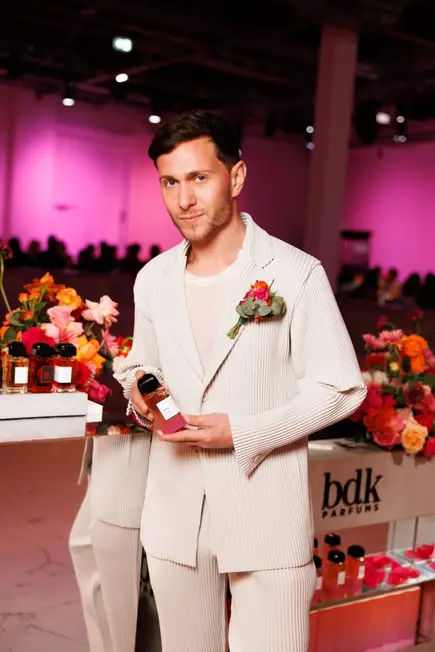
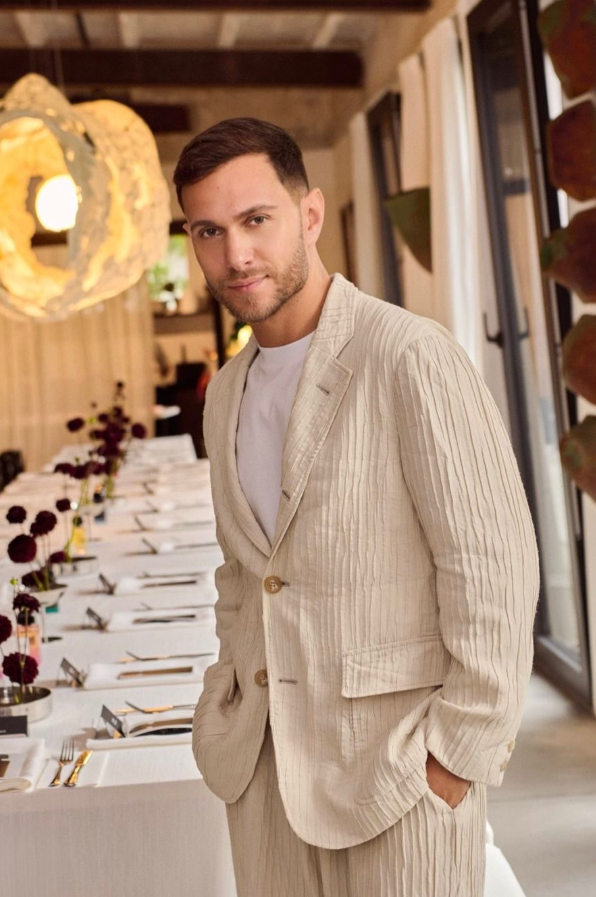
He was born into fragrance, but David Benedek did not simply inherit a perfume business. He built a new one. Today, the founder of BDK Parfums stands at the intersection of Parisian heritage, contemporary luxury and a rapidly expanding global fragrance market.
To understand David Benedek, you have to go back decades before the first bottle of BDK Parfums appeared.
Benedek was born in Paris in 1989 to a father of Romanian heritage and a mother from the border region between Algeria and Morocco. On his father’s side, his grandparents had been exiled from Transylvania before establishing themselves in Paris, where they became part of the city’s postwar fragrance trade. BDK describes them as among the early distributors in Paris of prestigious perfume names including Worth and Christian Dior.
This was not a distant family legend Benedek discovered as an adult. Perfume was quite literally part of the environment in which he grew up.
His paternal grandfather had been a lawyer in Romania but could not continue practicing the profession after moving to France. His grandmother, Édith, trained in beauty treatments and developed a clientele that included perfume-wearing women from the Hungarian community in Paris. Benedek has recounted that one request from Édith for Worth’s celebrated Je Reviens helped inspire his grandfather to investigate the fragrance business. He eventually began distributing perfume to American military personnel stationed in France before the family established its own Paris perfume business.
In 1959, his grandparents opened a perfumery in Paris near Rue Saint-Honoré and the Palais-Royal. That business became associated with Benlux, the luxury retailer that remains in Paris today. The shop specialized in fragrance and luxury products and became particularly connected with international visitors to the French capital. Benedek’s parents would continue the family business, meaning that by the time David was a child, perfume was not an abstraction. It was part of family life.
Édith appears repeatedly when Benedek talks about the person who shaped him. He has described spending time with her perfume collection as a child and listening to stories about houses and designers including Grès, Jacques Fath and Jean Patou. He was drawing perfume bottles when he was roughly eight to ten years old. Years later, when he created Bouquet de Hongrie, he made it a tribute to his grandmother and her Hungarian-speaking heritage. It became particularly emotional because it was the only BDK fragrance she was able to smell before her death.
His maternal background contributed another sensory vocabulary. Benedek has recalled the spices used in his mother’s cooking—cumin, nutmeg and saffron among them—as some of his early scent memories. The combination helps explain something important about BDK: although the house is unmistakably Parisian, Benedek’s personal references have never been restricted to a single French tradition. His creative world draws on family migration, North Africa, Central and Eastern Europe, travel, fashion, food, architecture and the different neighborhoods of Paris.



FROM BUSINESS STUDENT TO FRAGRANCE FOUNDER
Benedek did not immediately train as a traditional perfumer. He studied economics and business, spent time studying in Beijing and New York around 2010, and later entered the Institut Français de la Mode, where he specialized in perfume and cosmetics. The experience proved decisive. He trained in the recognition of raw materials and olfactory families with teams from Givaudan and subsequently deepened his fragrance education at Cinquième Sens.
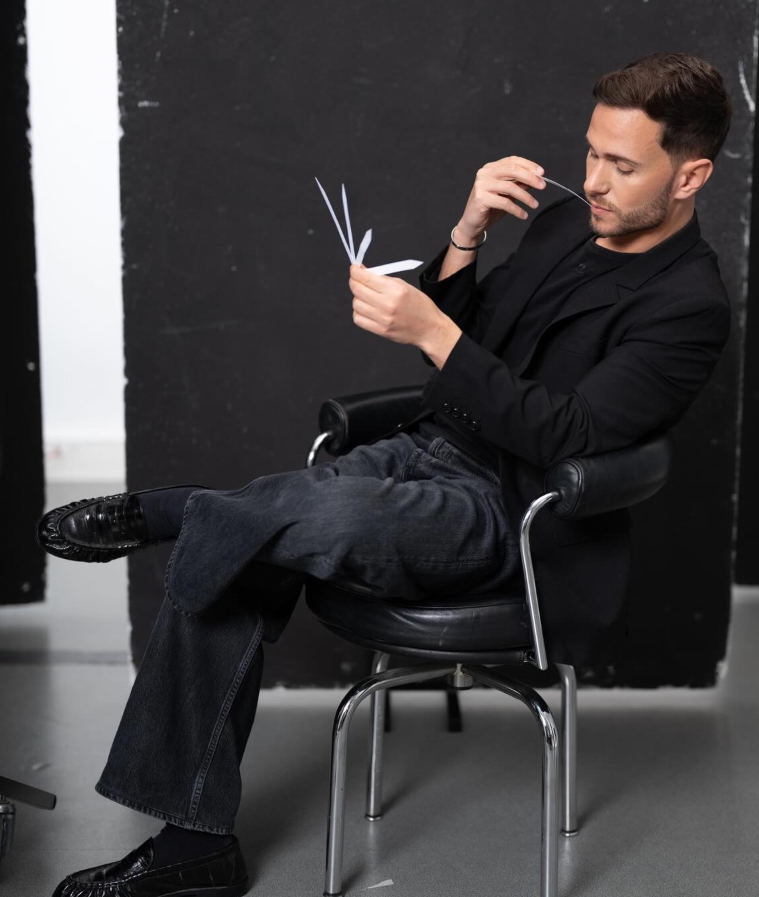
That distinction is important: Benedek is best understood as BDK’s founder, creative director and perfume designer rather than as the lone “nose” composing every formula himself. His model has always been collaborative. He creates concepts, stories, material directions and briefs, then works alongside perfumers including Mathilde Bijaoui, Alexandra Carlin, Amélie Bourgeois, Anne-Sophie Behaghel, Jordi Fernández, Dominique Ropion and others to translate those ideas into fragrance. Benedek has said that he deliberately did not want a house built around a single perfumer; he wanted a collective capable of adding different voices to the BDK vocabulary.
The idea for his own house began taking shape around 2014. On June 23, 2016, BDK Parfums officially launched in Paris.
The name itself is personal without being overtly so. Benedek has explained that BDK is derived from his surname, Benedek, and that using the abbreviated form allowed the name to feel more like a creative collective or studio than an ego-driven personal label. That philosophy continues to define how he describes the company today.
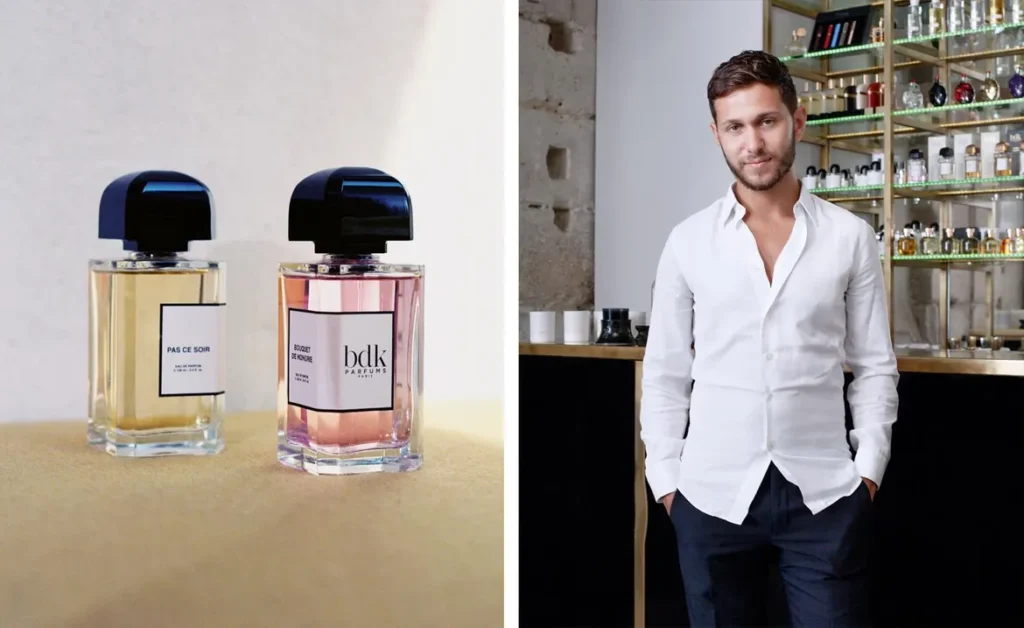
From the beginning, Paris provided the framework. BDK’s offices were established in the Palais-Royal district, returning Benedek to the same part of the city connected to his family’s perfume history. The bottle design also carried Paris into the brand identity, combining contemporary lines with Art Deco influences and referencing the architecture and rooftops of the city, including the Grand Palais.
The first collection consisted of five fragrances. One of Benedek’s pivotal early relationships was with David Frossard and the independent fragrance distribution world surrounding Liquides and Différentes Latitudes. Within months of launching, BDK was being sold at Le Bon Marché in Paris and beginning its expansion outside France.
THE FRAGRANCES THAT CHANGED THE BUSINESS
Several fragrances would eventually become much larger than the young company that created them.
Rouge Smoking, launched in 2018, drew from Pigalle, Paris nightlife and Benedek’s admiration for Yves Saint Laurent’s transformation of the masculine tuxedo into a statement of womenswear. The result captured something that would become central to BDK: sophistication mixed with tension, sensuality and a slightly rebellious Parisian attitude.
Then came Gris Charnel in December 2019.
Created with perfumer Mathilde Bijaoui, the composition would become BDK’s breakout success. Benedek himself has said its reception surpassed what he expected, particularly as the scent gained momentum through social media and word of mouth. Its success elevated BDK from a promising independent house into one of the most visible names in contemporary niche perfumery.
Recognition followed. Velvet Tonka, created with Alexandra Carlin, received a Fragrance Foundation France award in 2022, while Gris Charnel Extrait received the Fragrance Foundation USA’s Perfume Extraordinaire recognition in 2023.
What Benedek built was not merely a collection of successful smells. His concept was closer to an olfactory library: fragrances as individual stories, characters and environments that the wearer is allowed to interpret. BDK continues to describe its creations in terms of memory, imagination, raw materials and narrative rather than rigid gender categories. The concentrates are produced in the Grasse region, and the house emphasizes its relationships with French artisans and suppliers.
THE RETURN TO RUE SAINT-HONORÉ
The family’s Paris history came full circle in January 2024 when BDK opened its first flagship at 312 Rue Saint-Honoré.
For Benedek, the address carried considerable emotional weight. His grandparents had established their perfume business in the same wider neighborhood in 1959. More than six decades later, their grandson was opening a store for the fragrance house bearing letters taken from his own surname.
The flagship was conceived as a contemporary olfactory library rather than simply a retail counter. Stone, glass, concrete and minimalist architecture were used to create a physical expression of BDK’s aesthetic. Benedek subsequently translated the materials and atmosphere of the store into the fragrance 312 Saint-Honoré, created with Alexandra Carlin.
That ability to move between architecture, fashion, texture and scent is central to the way Benedek thinks. He has spoken about approaching fragrance visually, considering colors and textures before deciding what message a composition should communicate. In 2026, BDK made that relationship even more explicit through Collection Studio, a highly concentrated fragrance collection connecting haute perfumery with fashion, fabric and materiality.
SO, WHO OWNS BDK PARFUMS TODAY?
This is where the story recently changed.
For its first nine years, BDK developed without an outside equity investor. In November 2025, LVMH Luxury Ventures acquired a minority stake in BDK Parfums, marking the first time the company had opened its capital to an external investor. The financial terms and exact percentage were not publicly disclosed.
That does not mean LVMH bought BDK Parfums.
David Benedek remains the founder and leader of the house, and the investment was structured as a minority position. Benedek has emphasized that he retains creative freedom, while the LVMH-backed investment provides capital and expertise for hiring, international expansion, digital development and future retail locations. In May 2026, he said BDK’s French team had grown to 26 people, roughly doubling in about a year.
For Benedek, the arrangement appears designed to solve one of the classic problems facing founder-led luxury businesses: how to scale without allowing the mechanism of growth to destroy what made the company interesting in the first place. His stated ambition is not to flood the market with releases. In fact, he has said BDK intends to slow its launch cadence and spend more time developing existing fragrance icons and the wider identity surrounding them.
TEN YEARS LATER
BDK celebrated its tenth anniversary in 2026.
The company Benedek started in his twenties has become a global fragrance business, while remaining unusually connected to his family’s history. Bouquet de Hongrie carries the memory of his grandmother. Rouge Smoking reflects Parisian nightlife and fashion. Gris Charnel became the commercial turning point. 312 Saint-Honoré transformed a physical address into scent. The newest Studio collection pushes the house toward Benedek’s broader ambition of positioning BDK not simply as a perfume brand, but as a creative studio capable of moving between fragrance, art, fashion and design.
Expansion is coming. Benedek has discussed further development in the United States, Asia, the Middle East, the United Kingdom and other key markets, with an ambition of building roughly ten BDK boutiques by 2030. Yet his language around growth remains remarkably consistent: the company has to preserve a point of view.
That may ultimately be the most important part of David Benedek’s story.
He inherited access to perfume, knowledge of perfume and a family history built around selling perfume. What he did not inherit was BDK Parfums. He had to create that himself.
And a decade after its launch, with a global audience and one of luxury’s largest groups now invested in its future, Benedek’s challenge is no longer proving that BDK can succeed. It is proving that a young independent perfume house can become significantly larger without losing the intimacy, memory and creative freedom that made people care about it in the first place.
Photography: © Sheraz Debbich / Say Who Media. Additional photography and product imagery courtesy of BDK Parfums.