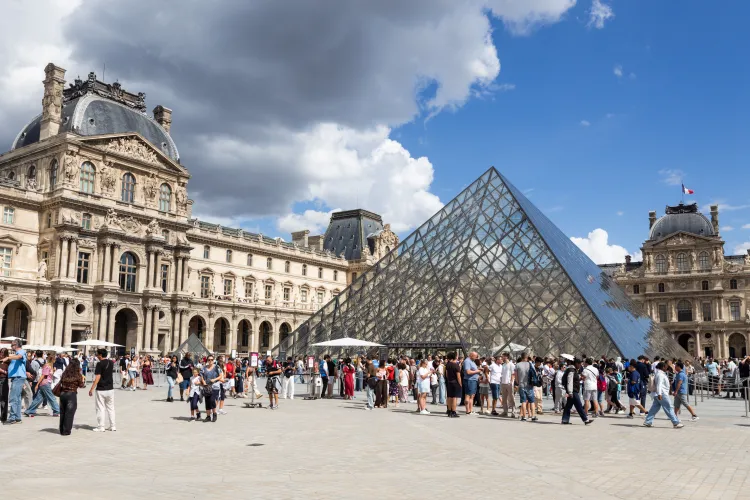
Choosing the Louvre as a protest site carried its own symbolism. Students of the École du Louvre rejected the idea that they were simply targeting an unrelated tourist attraction, arguing that the museum is also a place where they study, envision their professional futures and may eventually work. The blockade also occurred exactly one year after the October 19, 2025 robbery of France’s crown jewels at the museum, adding another layer to what has already been a turbulent period for the institution. Louvre workers themselves have repeatedly raised concerns about staffing, working conditions and the demands placed on one of the most heavily visited museums in the world.
Then there is Art Basel Paris. The Louvre demonstration was not a protest against Art Basel, an important distinction as the story travels internationally. But the timing could hardly have been more striking. Art Basel Paris begins its fifth edition at the Grand Palais this week with 211 exhibitors from 41 countries and territories. Its invitation-only Avant-Première began October 20, followed by preview days October 21 and 22 and public access from October 23 through October 25.
The unrest has nevertheless forced the art world to confront what is happening outside the fair. Art Basel has said its Paris edition will proceed as planned, while strengthening security around the Grand Palais. Organizers have added personnel to patrol the perimeter around the clock, maintained anti-ram barriers around the venue and implemented stricter visitor screening in coordination with private security and Paris authorities. Elsewhere in the city, the effects have already been felt: the Jeu de Paume canceled a VIP opening for Stan Douglas as a precaution, an exhibition opening at the École des Beaux-Arts was disrupted by another student blockade, and some galleries temporarily closed during the weekend unrest.
The commercial stakes are considerable. Art Basel Paris has become one of the city’s most important international cultural events, attracting collectors, dealers, artists, luxury brands and institutions from around the world. Le Monde reported that the fair generated approximately €432 million in economic benefits for Paris in 2024. Yet that money arrives against a considerably less glamorous reality inside the French gallery sector, where a new industry barometer found 86 percent of galleries pessimistic about their future and many businesses increasingly dependent on art fairs for a significant share of annual sales.
That is what makes this moment particularly revealing. In the same city, within days of one another, students were standing outside the Louvre demanding greater investment in public institutions while international collectors were arriving for a week built around some of the world’s most valuable contemporary art. They are not opposing sides of the same protest, nor should they be presented that way. But they expose two very different realities operating inside the same cultural ecosystem: culture as a public institution that requires funding, labor and access, and culture as an international market driven by collectors, galleries and capital.
For now, Art Basel Paris remains on schedule. The Louvre is ordinarily closed on Tuesdays, making October 20 its regular weekly closure, and attention will turn to what happens when the museum is next scheduled to welcome visitors. With France’s wider protest movement continuing and further demonstrations already being discussed, Paris Art Week is moving forward—but it is doing so in a city where the political atmosphere can no longer be separated from the cultural one.
Photo Source: AP News